
Somewhere along the way, we decided shareholders were the most important people in the economy.
That decision has done enormous damage.
It has warped businesses, weakened workers, raised prices, encouraged short-term thinking, hollowed out services, and turned entire industries into machines for extracting value rather than creating it.
Shareholders matter.
But they should not matter most.
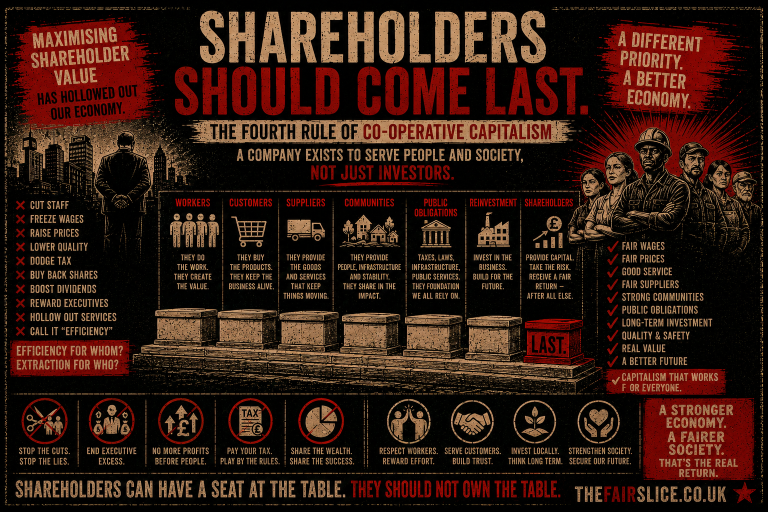
That is the fourth rule of Co-operative Capitalism:
Shareholders should come last.
Who actually keeps a business alive?
A business does not exist because shareholders exist.
A business exists because workers produce something, customers buy something, suppliers provide something, communities support something, and society provides the conditions that allow the whole thing to function.
Workers make the product, deliver the service, solve the problems, speak to the customers, clean the buildings, run the systems, drive the vans, pack the orders, grow the food, provide the care.
Customers provide the revenue.
Suppliers keep the operation moving.
Communities provide the labour force, local infrastructure and social stability.
The state provides roads, courts, laws, education, emergency services, healthcare, public order and economic conditions.
Shareholders provide capital.
That can be useful.
But it does not make them gods.
The shareholder myth
The modern economy often acts as if the purpose of a company is to maximise shareholder value.
That sounds professional and sensible.
It is not.
It is a moral choice dressed up as business logic.
It says the people who own shares should be prioritised above almost everyone else.
Above workers who need decent wages.
Above customers who need fair prices.
Above suppliers who need fair treatment.
Above communities that need stable employment.
Above long-term investment.
Above product quality.
Above public responsibility.
Once a company accepts that logic, everything becomes easier to justify.
Cut staff.
Freeze wages.
Raise prices.
Outsource work.
Reduce quality.
Delay investment.
Avoid tax.
Lobby government.
Close local sites.
Buy back shares.
Boost dividends.
Reward executives.
Then call it efficiency.
But efficiency for whom?
Dividends should not come before dignity
Under Co-operative Capitalism, shareholder returns would only come after basic obligations are met.
That means a company should not be paying large dividends if it is underpaying workers.
It should not be buying back shares if it is cutting staff.
It should not be rewarding investors if it is failing customers.
It should not be extracting profit if it is squeezing suppliers below sustainable levels.
It should not be handing money upward if it is relying on public subsidy, poor conditions, unpaid overtime, or tax avoidance.
This is not complicated.
Before shareholders are paid, the company should prove it is behaving responsibly.
Workers paid properly.
Suppliers treated fairly.
Customers charged reasonably.
Taxes paid honestly.
Pensions protected.
Safety maintained.
Quality preserved.
Communities respected.
Then, and only then, should excess profit be distributed to shareholders.
Share buybacks need serious limits
Share buybacks are a perfect symbol of the problem.
A company uses its own money to buy back its shares, often boosting the share price and rewarding shareholders and executives.
Sometimes there may be a legitimate argument for this.
But too often, buybacks become a way of moving money upward instead of investing in the real business.
That money could have gone into wages.
Training.
Research.
Safety.
Lower prices.
Better staffing.
New equipment.
Pension security.
Debt reduction.
Customer service.
Instead, it is used to flatter the share price.
That is not productive capitalism.
That is financial engineering.
Under Co-operative Capitalism, share buybacks would be restricted, especially where companies have poor pay, weak service, high prices, underinvestment or heavy reliance on public contracts.
Public money should not fund private extraction
This rule matters even more when public money is involved.
If a company receives government contracts, subsidies, bailouts, tax breaks or public support, then shareholder extraction should be tightly limited.
You should not be able to take public money with one hand and pay out excessive dividends with the other.
Public money should support public outcomes.
Jobs.
Services.
Infrastructure.
Quality.
Resilience.
Fair wages.
It should not be a pipeline from taxpayers to shareholders.
If companies want the benefits of public support, they should accept public obligations.
Investors can still earn
Again, this is not about banning investment.
People who invest money can receive a return.
Pension funds need returns.
Small investors can benefit.
Capital can help businesses grow.
But returns should be reasonable, not sacred.
Investment should serve the real economy.
It should not dominate it.
The problem is not that shareholders get paid.
The problem is that everyone else is too often sacrificed to make sure shareholders get paid first.
Co-operative Capitalism reverses that priority.
The proper order
The proper order should be simple.
First, workers.
Then customers.
Then suppliers.
Then communities.
Then public obligations.
Then reinvestment.
Then shareholders.
Not because shareholders are evil.
But because they are not the foundation of society.
A shareholder risking spare capital should not matter more than a worker risking their health, time and future.
They should not matter more than a customer being overcharged.
They should not matter more than a supplier being squeezed.
They should not matter more than the public services and infrastructure that make business possible.
Shareholders can have a seat at the table.
They should not own the table.