
The economy is not failing by accident.
It is doing what it has been trained to do.
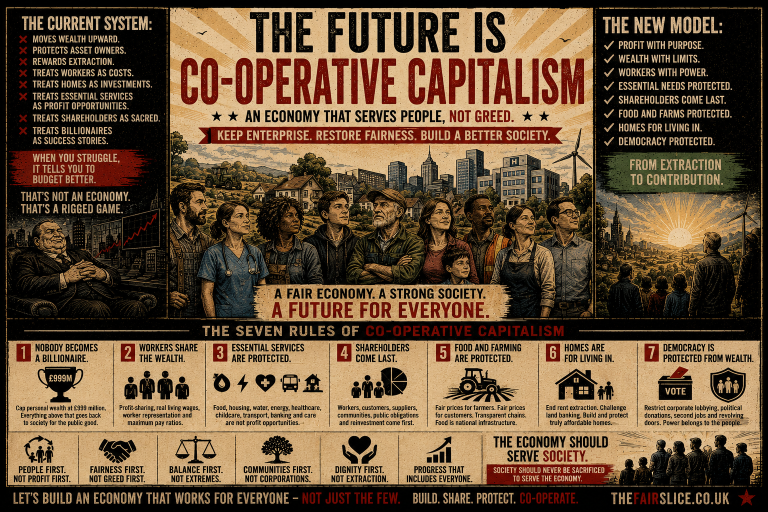
It moves wealth upward.
It protects asset owners.
It rewards extraction.
It treats workers as costs.
It treats homes as investments.
It treats essential services as profit opportunities.
It treats shareholders as sacred.
It treats billionaires as success stories.
Then, when ordinary people struggle, it tells them to budget better.
That is not a serious economic system.
That is a rigged game with motivational posters.
We need something better.
Not a fantasy.
Not a slogan.
Not a vague hope that the richest people and biggest companies will suddenly develop a conscience.
We need rules.
That is why the future should be Co-operative Capitalism.
What Co-operative Capitalism means
Co-operative Capitalism keeps the useful parts of capitalism.
Enterprise.
Innovation.
Trade.
Choice.
Risk-taking.
Small business.
Private ownership.
Reward for effort.
Reward for useful ideas.
Reward for building something that works.
But it rejects the poison.
Unlimited accumulation.
Billionaire hoarding.
Shareholder supremacy.
Corporate lobbying.
Poverty wages.
Rent extraction.
Essential service profiteering.
Political capture.
It says profit can exist, but not above human need.
It says business can thrive, but not by bleeding workers, customers, suppliers and communities dry.
It says wealth can be earned, but not hoarded without limit.
It says markets can be useful, but they must serve society.
That is not extremism.
That is basic sense.
The seven rules together
The model is built around seven rules.
First, nobody becomes a billionaire.
A society that cannot afford functioning hospitals, schools, councils, housing and care cannot afford billionaires. Once someone reaches £999 million, they have won capitalism. Everything above that should return to the society that made such wealth possible.
Second, workers share the wealth they create.
No company should be praised as successful while its workers are underpaid. Profit-sharing, real living wages, worker representation and maximum pay ratios should become normal parts of business.
Third, essential services are protected from profiteering.
Food, housing, water, energy, healthcare, childcare, transport, banking and care are not ordinary products. They are basic needs. Reasonable profit is acceptable. Exploiting dependency is not.
Fourth, shareholders come last.
Workers, customers, suppliers, communities, public obligations and reinvestment should come before dividends and share buybacks. Shareholders can receive returns, but not at everyone else’s expense.
Fifth, food and farming are protected.
Farmers should receive fair prices. Customers should not be ripped off. Supermarkets, processors and middlemen should face scrutiny where they squeeze both ends of the chain. Food is national infrastructure.
Sixth, homes are for living in.
Housing should provide shelter, security and dignity. It should not be primarily a wealth extraction machine. Rent harvesting, land banking, empty homes and speculative ownership should be challenged.
Seventh, democracy is protected from wealth.
Corporate lobbying, political donations, second jobs, revolving doors and private influence must be restricted. Democracy cannot survive if money can buy power.
Together, these rules create a simple shift.
From extraction to contribution.
From hoarding to circulation.
From shareholder-first to society-first.
From greed as the default to fairness as the standard.
This is more practical than the current system
Critics will call this unrealistic.
But look at what they are defending.
They are defending a system where people work full-time and still cannot afford a decent life.
A system where rents swallow wages.
A system where public services are permanently under strain.
A system where farmers struggle while food prices rise.
A system where essential workers are praised in speeches and underpaid in reality.
A system where politicians tell the public there is no money while enormous private wealth piles up at the top.
A system where companies can post large profits while customers are squeezed and staff are exhausted.
A system where billionaires are treated as normal but food banks are treated as inevitable.
That is what is unrealistic.
It is unrealistic to think society can survive indefinitely when wealth keeps concentrating upward.
It is unrealistic to expect workers to stay productive while becoming poorer.
It is unrealistic to expect young people to believe in democracy when housing is unaffordable and politics looks bought.
It is unrealistic to let essential services become extraction points and then act surprised when people are angry.
Co-operative Capitalism is not the fantasy.
The fantasy is believing the current model can carry on forever without consequences.
This is not about envy
Another lazy criticism will be envy.
Apparently, wanting a fairer economy means being jealous of success.
No.
This is not envy.
It is structure.
It is not envy to say workers should be paid properly.
It is not envy to say children should not be hungry.
It is not envy to say homes should be affordable.
It is not envy to say nurses, teachers, carers and farmers matter more than shareholder returns.
It is not envy to say democracy should not be for sale.
It is not envy to say nobody needs more than £999 million.
Calling every demand for fairness “envy” is just a way to avoid defending greed.
Good business should welcome this
A genuinely good business should not fear Co-operative Capitalism.
If you pay workers properly, treat customers honestly, deal fairly with suppliers, pay tax responsibly, invest in quality and make a reasonable profit, this model is not your enemy.
In fact, it helps you.
Because it stops bad businesses from undercutting you through exploitation.
It stops companies winning by paying poverty wages.
It stops competitors squeezing suppliers below sustainability.
It stops monopolies and giants from using power to distort the market.
It creates a healthier economy where people have enough money to buy goods and services.
It builds social stability.
It creates better customers, better workers and better communities.
A fair economy is not anti-business.
It is pro-good-business.
It is anti-parasite.
The moral question
At some point, every economic argument becomes a moral argument.
What do we value?
Who matters?
What is enough?
What should never be for sale?
How much inequality are we willing to tolerate?
How much suffering are we willing to excuse?
How much wealth should one person be allowed to hoard while others go without basics?
How much influence should money have over democracy?
These are not technical questions.
They are moral ones.
And right now, our answers are ugly.
We have allowed the economy to behave as if profit matters more than dignity.
As if ownership matters more than work.
As if wealth matters more than need.
As if markets are more important than people.
Co-operative Capitalism gives a different answer.
People first.
Work first.
Homes first.
Food first.
Public services first.
Democracy first.
Profit after responsibility.
Wealth after contribution.
Markets after society.
The future we should choose
The future does not have to be billionaire rule, collapsing services, unaffordable homes, insecure work, expensive food, corporate politics and permanent public exhaustion.
We can choose something else.
We can build an economy where businesses still exist, but greed is restrained.
Where workers share success.
Where essential services are protected.
Where farms are treated as vital.
Where homes are homes again.
Where shareholders are not worshipped.
Where politics cannot be bought.
Where wealth circulates instead of being hoarded.
Where success is allowed, but extraction is not.
That is the future worth arguing for.
Not because it is perfect.
But because it is better.
And because the current system is not just unfair.
It is failing.
The economy should serve society.
Society should not be sacrificed to serve the economy.
That is the case for Co-operative Capitalism.