
Food is not just another product.
Food is survival.
It is health, security, culture, family, land, labour, community and national resilience.
So why do we allow the food system to be run as if the only question that matters is who can squeeze the hardest?
Farmers are squeezed.
Customers are squeezed.
Workers are squeezed.
And somehow, somewhere in the middle, profit still appears.
That should tell us something.
If the farmer is struggling and the customer is being ripped off, the money is hiding somewhere in the chain.
That is why food and farming need to sit at the heart of Co-operative Capitalism.
Farmers should not be disposable
A country that cannot feed itself is vulnerable.
That does not mean every single thing must be produced domestically. Trade matters. Imports matter. Choice matters.
But domestic farming should be treated as essential national infrastructure.
Because it is.
Farmers manage land.
They produce food.
They maintain rural economies.
They deal with weather, disease, rising costs, regulation, uncertainty and volatile markets.
Yet too often, farmers are treated as the weakest link in the chain.
Supermarkets want low prices.
Processors want margins.
Customers face high prices.
Governments offer warm words.
And farmers are left trying to survive between rising costs and downward pressure from powerful buyers.
That is not sustainable.
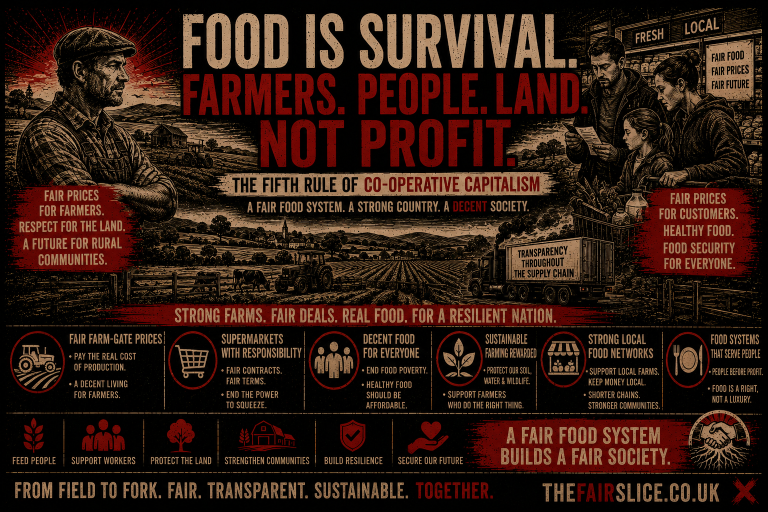
Fair farm-gate prices
The first principle should be fair farm-gate pricing.
Farmers should receive prices that reflect the real cost of production.
That includes labour, feed, fuel, energy, equipment, land management, environmental responsibilities, animal welfare, reinvestment and a decent income.
If we want high standards, we have to pay for high standards.
We cannot demand cheap food, high welfare, environmental protection, local production and resilient supply chains while allowing farmers to be paid below sustainable levels.
That is fantasy economics.
Co-operative Capitalism would require greater transparency in food supply chains so we can see who gets what.
If the farmer receives pennies and the customer pays pounds, the public deserves to know where the difference goes.
Supermarkets need scrutiny
Supermarkets are powerful.
Very powerful.
They decide what gets shelf space.
They influence prices.
They shape consumer behaviour.
They pressure suppliers.
They dominate access to the market.
With that power should come serious responsibility.
Supermarkets should not be allowed to squeeze producers while presenting themselves as champions of ordinary shoppers.
They should not be allowed to push risks down the supply chain while protecting their own margins.
They should not be allowed to use complexity to hide where profits are being made.
This does not mean supermarkets cannot profit.
It means they should not be allowed to exploit their position.
Margins in essential food supply should be monitored.
Contracts with producers should be fair.
Payment terms should be reasonable.
Wasteful cosmetic standards should be challenged.
Local sourcing should be supported.
And where supermarkets make large profits during a cost-of-living crisis, they should expect scrutiny.
Customers are being squeezed too
The public is not imagining it.
Food shopping feels more expensive because it is more expensive.
People are changing what they buy.
Families are trading down.
Some are skipping healthier food because cheaper calories are easier to afford.
Food banks have become normalised in one of the wealthiest countries in the world.
That should shame us.
Food poverty is not just about individual hardship.
It is a sign of system failure.
When people working full-time cannot reliably afford decent food, the economy is broken.
When children go to school hungry, the economy is broken.
When parents water down meals so everyone gets something, the economy is broken.
When farmers cannot make a living producing food and customers cannot afford to buy food, the economy is not efficient.
It is sick.
Sustainable farming should be rewarded
A fair food system must also be sustainable.
Soil health matters.
Water quality matters.
Biodiversity matters.
Animal welfare matters.
Carbon emissions matter.
Flood resilience matters.
Local ecosystems matter.
But we cannot simply load environmental responsibilities onto farmers without supporting them.
If society wants better land stewardship, society must help pay for it.
Co-operative Capitalism would reward regenerative farming, mixed farming, soil restoration, wildlife corridors, responsible water use, lower chemical dependency, and long-term land health.
Not through vague slogans.
Through real financial incentives.
Farmers should not be punished for doing the right thing.
They should be supported to do it.
Local food networks
We also need stronger local and regional food systems.
Not as a replacement for all national and international trade, but as a safeguard.
Local markets.
Food co-operatives.
Community-supported agriculture.
Public procurement from local farms.
School meals using regional suppliers.
Hospitals buying from nearby producers.
Councils supporting local food hubs.
This keeps more money in communities.
It shortens supply chains.
It gives farmers more routes to market.
It gives customers better connection to where food comes from.
It makes the system less fragile.
Food should not be controlled only by a handful of giant buyers and suppliers.
The food system should serve people
The purpose of the food system should be obvious.
To feed people well.
To provide farmers with a decent living.
To protect land.
To support communities.
To make healthy food accessible.
To ensure national resilience.
But right now, too much of the system is designed around power and margin.
Co-operative Capitalism would change the question.
Not: how cheaply can we force farmers to sell?
Not: how much can supermarkets charge?
Not: how much profit can be extracted between field and fork?
But:
Is the farmer paid fairly?
Is the worker paid properly?
Is the customer charged reasonably?
Is the land protected?
Is the supply chain resilient?
Is the country being fed well?
Food is too important to be left to corporate greed.
A fair economy starts with a fair food system.