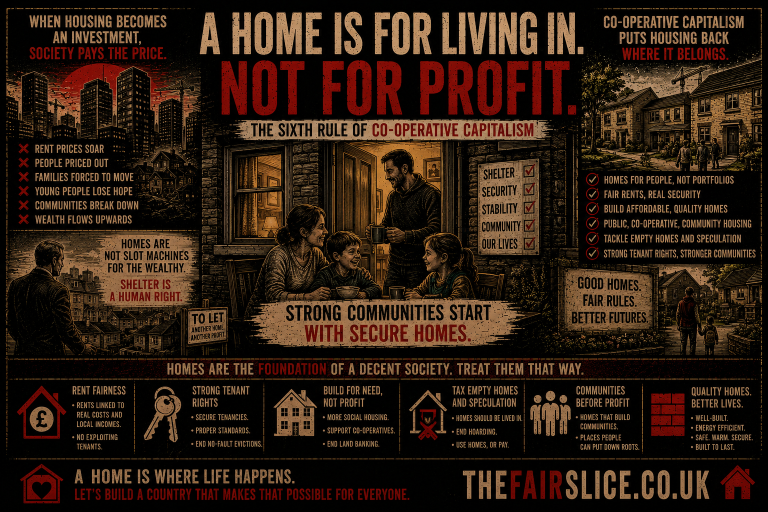

A home is not just an asset.
It is shelter.
It is safety.
It is where people sleep, recover, raise children, care for relatives, build routines, rest, argue, cook, laugh, grieve and live their actual lives.
So when housing becomes primarily an investment product, society starts to rot.
Because if homes exist mainly to generate wealth for those who already own property, then everyone else is forced to pay for someone else’s financial strategy.
That is not a housing system.
That is extraction with front doors.
Housing is not a normal market
People talk about housing as if it works like any other market.
If something costs too much, choose something else.
But housing does not work like that.
People need to live near jobs, schools, families, transport, childcare, support networks and communities.
Moving is expensive.
Deposits are expensive.
Buying is out of reach for many.
Renting is often insecure.
Waiting lists are long.
Supply is limited.
And everyone needs somewhere to live.
That means landlords, developers, lenders and investors hold enormous power.
When one side needs shelter and the other side owns the shelter, the relationship is not equal.
Co-operative Capitalism would start by recognising that reality.
Rent should reflect real costs, not desperation
Rent should not simply be whatever a landlord can get away with.
It should be linked to real costs, property standards, local incomes, maintenance, mortgage costs where relevant, and reasonable return.
Not unlimited return.
Reasonable return.
A landlord should not be able to endlessly raise rent simply because tenants are trapped in a broken market.
If wages are not rising at the same pace, if local people are being priced out, if families are forced to move repeatedly, if renters cannot save because rent eats everything, then the system is failing.
The defence is always the same: the market decides.
But when the market decides that working people cannot afford homes, the market is wrong.
Buy-to-let needs tighter rules
Buy-to-let has helped turn homes into income streams.
That does not mean every landlord is evil. Some are decent. Some maintain properties well. Some charge fair rents. Some provide secure homes.
But the wider model has serious problems.
When people with access to capital buy homes that others need to live in, prices rise.
When landlords use tenants to pay off mortgages, wealth transfers from those without assets to those with assets.
When housing becomes a way to build passive income, the basic purpose of housing gets corrupted.
Co-operative Capitalism would regulate buy-to-let much more tightly.
Higher taxes on multiple property ownership.
Limits on rent increases.
Stronger tenant rights.
Minimum standards with real enforcement.
Restrictions on highly leveraged rental models.
Greater support for first-time buyers and co-operative housing.
The goal should be to reduce the number of people forced to rent from private landlords because ownership or social housing is impossible.
Empty homes should be taxed hard
Leaving homes empty while people need somewhere to live should be socially unacceptable.
There may be short-term reasons for a property to be empty: renovation, probate, sale, safety work.
But long-term empty homes should face serious taxation.
If someone wants to hold housing as an idle asset, they should pay heavily for the privilege.
The same applies to homes used mainly as investment stores while local people are priced out.
A house is not a gold bar with plumbing.
It is part of a community.
If you own housing, you have responsibilities.
Developers should not control supply for profit
Developers also need scrutiny.
We are often told the answer to the housing crisis is simply to build more homes.
We do need more homes.
But the question is what kind, where, for whom, at what price, and under whose control.
If developers are allowed to sit on land, slow delivery, drip-feed supply, prioritise executive homes, reduce affordable housing obligations, and protect margins, then building alone will not solve the crisis.
We need homes people can actually afford.
Council housing.
Co-operative housing.
Community land trusts.
Affordable ownership.
Secure rental homes.
Family homes.
Accessible homes.
Homes near transport, schools and services.
Not just more units designed to maximise return.
Land banking should be restricted.
Planning gain should benefit communities.
Affordable housing commitments should be enforced.
Public land should be used for public good, not sold off cheaply for private profit.
Public and co-operative housing
A serious housing future must include a major expansion of public and co-operative housing.
For decades, public housing has been weakened, sold off, stigmatised and underbuilt.
That was a political choice.
It can be reversed.
Good public housing gives people security.
It reduces pressure on the private rental market.
It gives families stability.
It helps workers live near their jobs.
It stops housing from being entirely controlled by private landlords and developers.
Co-operative housing adds another route.
Residents can have a stake, a voice and shared responsibility.
Housing can be run for stability rather than extraction.
That is exactly the kind of model Co-operative Capitalism should encourage.
Housing affects everything
Housing is not a side issue.
It affects health.
It affects education.
It affects work.
It affects relationships.
It affects whether people have children.
It affects whether people can save.
It affects whether communities survive.
It affects whether young people have hope.
If housing is insecure, life is insecure.
If rent is too high, wages disappear.
If ownership is impossible, wealth inequality grows.
If families are moved from place to place, community breaks down.
If people spend half their income on shelter, the rest of the economy suffers too.
A broken housing market poisons everything around it.
The basic principle
Homes are for living in.
That should be the starting point.
Not portfolios.
Not passive income.
Not speculative assets.
Not short-term extraction.
Not a ladder pulled up by those who already climbed it.
A civilised housing system would make secure shelter normal.
It would reward good building, good maintenance and fair provision.
It would not reward hoarding, scarcity, rent harvesting and land speculation.
A society that lets people become rich by making shelter unaffordable is not civilised.
Co-operative Capitalism would put housing back in its proper place.
A home first.
An investment second.
And never a weapon.