
Democracy is not just voting every few years.
That is the ceremony of democracy.
The substance of democracy is whether ordinary people have real influence over the decisions that shape their lives.
And that substance is being hollowed out.
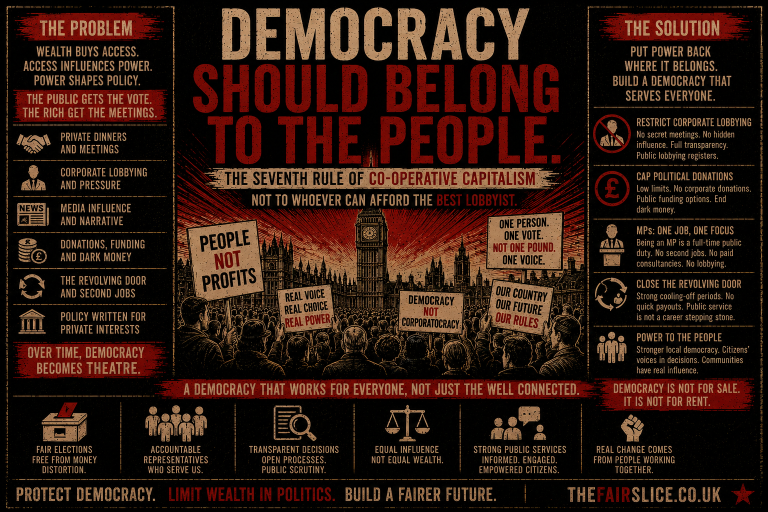
Because when wealth can buy access, lobbying, media influence, donations, consultancy networks, think tank output, legal pressure and post-political careers, democracy becomes theatre.
The public gets the vote.
The rich get the meetings.
That is not good enough.
Money changes politics
Wealth does not need to openly control politics to distort it.
It does not need to announce itself.
It does not need to walk into Parliament with a sack of cash and a villainous laugh.
It works more quietly than that.
Private dinners.
Consultancy jobs.
Lobbying meetings.
Donation networks.
Media pressure.
Party funding.
Think tanks.
Advisory roles.
Second jobs.
Future board positions.
Revolving doors.
Policy reports written in the language of “growth” and “competitiveness” but serving narrow private interests.
Over time, politicians learn who matters.
They learn whose calls are returned.
They learn whose concerns are treated as serious.
They learn whose anger creates consequences.
That is how democracy gets bent.
Corporate lobbying should be heavily restricted
Lobbying is often defended as information-sharing.
Sometimes that is true.
Government does need to hear from businesses, workers, charities, experts, unions, public bodies and communities.
But corporate lobbying is not neutral when one side has far more money, access and professional influence than everyone else.
A multinational corporation can hire teams of lobbyists.
A nurse cannot.
A billionaire can fund a think tank.
A care worker cannot.
A landlord association can push policy.
A struggling tenant often cannot even get through to their MP.
That imbalance matters.
Co-operative Capitalism would heavily restrict corporate lobbying.
Meetings should be transparent.
Lobbying records should be public.
Policy influence should be traceable.
Corporate gifts and hospitality should be banned or tightly controlled.
Former ministers should not be allowed to immediately sell their access to private interests.
If a company wants to influence public policy, the public should know exactly how, when and why.
Political donations should be capped
Political donations are another route for wealth to gain influence.
Nobody should be able to buy a louder political voice because they have more money.
Parties need funding.
Campaigns cost money.
But political finance should be designed to protect democracy, not sell access to it.
Donations should be capped at a low level.
Corporate donations should be banned or severely restricted.
Donor identities should be transparent.
Dark money should be shut down.
Political funding should come from many small contributions, public support mechanisms, membership, and tightly regulated sources.
If democracy is supposed to be one person, one vote, then money should not be allowed to create one billionaire, one megaphone.
MPs should not have second jobs
Being an MP should be a full-time public duty.
Not a side hustle.
Not a networking platform.
Not a stepping stone.
Not a personal brand-building exercise.
MPs are already paid well compared with most people in the country. The idea that they also need additional jobs while representing constituents is insulting.
If someone is elected to Parliament, that should be their job.
Their full job.
Their loyalty should be clear.
Their time should be focused.
Their judgement should not be clouded by outside income.
There may need to be narrow exceptions for things like medical professionals doing limited shifts to maintain qualifications, or reservists, or specific public-interest roles. But the principle should be firm.
No consultancy work.
No corporate advisory roles.
No paid lobbying.
No second career running alongside public office.
If you want to serve the public, serve the public.
If you want to serve corporate clients, do that instead.
Do not do both.
The revolving door must close
The revolving door between politics and corporate power is one of the clearest signs that the system is rotten.
A minister oversees an industry.
Then leaves office.
Then gets paid by companies connected to that industry.
Even when no rule is technically broken, the public can see the problem.
People are not stupid.
They understand incentives.
They understand that if politicians know a lucrative private-sector role may be waiting after office, that can shape behaviour while they are still in power.
Co-operative Capitalism would create much stronger cooling-off periods.
Former ministers, senior civil servants and regulators should be restricted from taking jobs in sectors they recently oversaw.
Advisory roles should be scrutinised.
Consultancy work should be transparent.
Public service should not become a route to private enrichment.
Public service should mean public service
Politics should attract people who want to improve society.
Not people looking for status, media careers, corporate networks, book deals, speaking fees and board seats.
Of course politicians should be paid fairly.
We do not want politics reserved only for the independently wealthy.
But there is a difference between fair pay and political careerism.
There is a difference between public service and personal advancement.
A healthy democracy needs politicians who remember who they work for.
Not donors.
Not lobbyists.
Not future employers.
Not newspaper owners.
Not corporate boards.
The public.
Why this matters to economic reform
This is the rule that protects all the other rules.
Because we can talk about wealth caps, worker power, housing reform, food fairness and essential service regulation all day.
But if the richest people and largest corporations can quietly influence the rules, reform will be weakened, delayed, watered down or killed.
That is the pattern.
A bold idea enters politics.
Lobbyists circle.
Warnings appear about business confidence.
Newspaper columns panic about extremism.
Think tanks produce reports.
Donors apply pressure.
Politicians retreat.
The final policy becomes a polite suggestion with loopholes large enough to drive a yacht through.
That is why democracy must be protected from wealth.
Without that, every other reform is vulnerable.
Democracy or managed decline
The country has a choice.
We can continue pretending that democracy is healthy because people are allowed to vote occasionally.
Or we can ask whether the public actually has meaningful control over the economy, public services, housing, food, energy and work.
Because if money can buy access to power, democracy becomes theatre.
And if democracy becomes theatre, people eventually stop believing in it.
That is dangerous.
Co-operative Capitalism requires a politics that cannot be bought.
A politics where public office is a duty.
A politics where corporate influence is limited.
A politics where wealth does not get a private entrance to power.
Democracy should belong to the people.
Not to whoever can afford the best lobbyist.