
These corporations told the public that higher prices were unavoidable. They blamed inflation, wages, disrupted supply chains, animal feed, transport costs, port congestion and Russia’s invasion of Ukraine. Some of those pressures were real—but so were the extraordinary profits collected while households struggled to pay for food, fuel and other essentials.
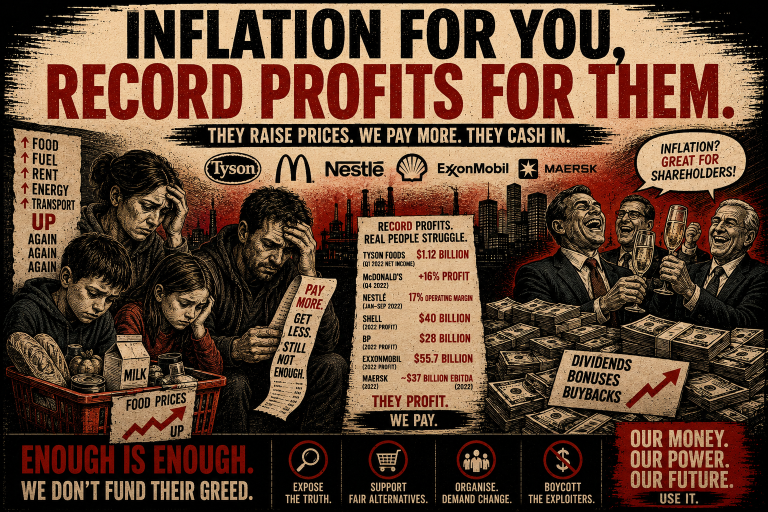
Tyson Foods raised average prices by 18.2% in one 2022 quarter. Earlier, it increased pork prices by 39.3%, chicken by 15.6% and beef by 11.6%. Management said it faced “unprecedented and accelerating inflation.” Yet Tyson’s quarterly net income climbed to $1.12 billion—more than twice the previous year’s result. Costs increased, but consumers were charged enough to produce a spectacular corporate payday. Reuters, Reuters
McDonald’s increased US menu prices by approximately 10% year over year in 2022, citing higher food, packaging, energy and labour costs. Its quarterly profit nevertheless rose 16%. When commodity costs subsequently began falling, Reuters reported that the company’s already elevated menu prices were helping produce “fatter margins.” Consumers absorbed the increases immediately; the relief from falling costs was far slower to reach them. Reuters, Reuters
Nestlé repeatedly increased the prices of coffee, dairy products, pet food and other household staples. In the first nine months of 2022, pricing accounted for 7.5 percentage points of its 8.5% organic sales growth, while the company maintained an operating margin of roughly 17%. Nestlé said higher prices were necessary to counter rising ingredient and supply-chain costs. Whatever the explanation, almost all of its reported growth came not from selling substantially more products, but from charging consumers more for them. Reuters
The oil industry’s windfall was even more staggering. Shell reported a record $40 billion profit for 2022. BP reported a record $28 billion. ExxonMobil made a record $55.7 billion. Together, the five largest Western oil companies—Shell, BP, ExxonMobil, Chevron and TotalEnergies—earned $219 billion, more than double their combined 2021 profit and an industry record. They attributed the market upheaval to constrained supply and Russia’s invasion of Ukraine. Those events explain why energy prices rose; they do not make the resulting transfer of wealth from struggling households to corporate shareholders any less grotesque. Reuters, Reuters, AP, Reuters
Maersk presents the same pattern at sea. Pandemic disruption and congested ports drove container-freight rates to record levels. Those charges were passed through supply chains and ultimately appeared in the prices paid by consumers. Maersk then recorded extraordinary 2022 earnings, with underlying EBITDA projected at approximately $37 billion. Supply-chain chaos was presented as a burden, but for one of the world’s dominant shipping companies it was also an immensely profitable business environment. Reuters, Reuters
These figures do not prove that every price increase was fraudulent or that every additional dollar represented profiteering. Costs genuinely rose, and market prices are not always controlled by a single company. But they demolish the suggestion that corporations were merely helpless victims passing unavoidable costs along. A business whose profits double—or reach the highest level in its history—is not simply absorbing an emergency. It is benefiting from it.
The public was told to accept smaller portions, more expensive groceries, punishing energy bills and inflated transport costs as unavoidable sacrifices. Meanwhile, shareholders received enormous dividends and stock buybacks. Losses and hardship were socialised; the rewards were privatised.
We are not powerless. We can expose these figures, support independent and lower-priced alternatives, demand stronger competition and windfall-profit rules, and withdraw our money from companies that treat every crisis as an opportunity to extract more. If they refuse to respect their customers, then we should refuse to fund them: organise, substitute, boycott—and stop buying their products.