
There is a difference between selling someone a luxury and selling someone something they need to survive.
That difference should matter.
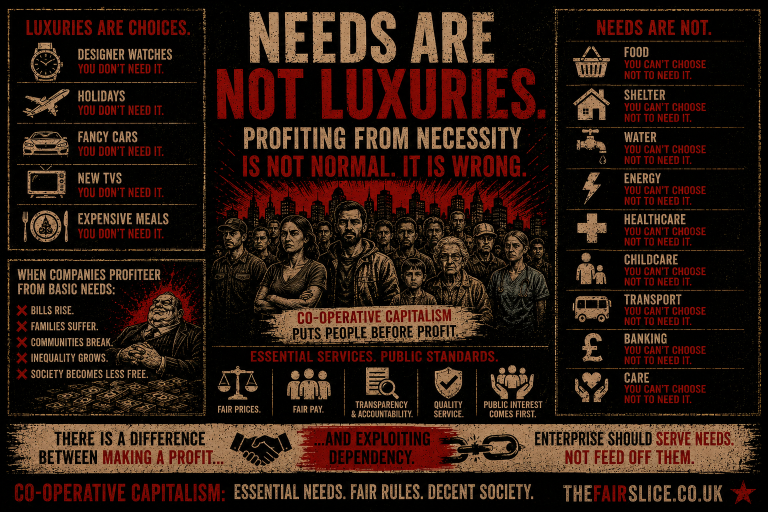
A person can choose not to buy a designer watch.
They can choose not to go on holiday.
They can choose not to buy a new television, a fancy car, or an expensive meal out.
But they cannot choose not to need food.
They cannot choose not to need shelter.
They cannot choose not to need water, energy, healthcare, childcare, transport, banking, or care.
That is why essential services should not be treated like ordinary markets.
They are too important.
And when companies are allowed to profiteer from basic human need, society becomes poorer, harsher and less free.
Necessity is not choice
One of the great myths of modern economics is that customers can simply shop around.
If a company charges too much, go somewhere else.
If a landlord raises the rent, move.
If food prices rise, buy different food.
If energy bills are high, switch provider.
If childcare is unaffordable, find another nursery.
This sounds neat in theory.
In real life, it often falls apart.
People need to live near work, family, schools and transport.
People have dietary needs.
People have children.
People have health conditions.
People have limited time, limited money, limited options and limited bargaining power.
A market is not truly free when one side cannot walk away.
And in essential sectors, people often cannot walk away.
That gives companies enormous power.
Co-operative Capitalism would recognise that power and regulate it properly.
Reasonable profit is not the enemy
This is important.
The argument is not that every company providing an essential service must make no profit.
That is too simplistic.
A food producer needs to survive.
A builder needs to make money.
A childcare provider needs to pay staff and cover costs.
A transport company needs to invest.
A care provider needs financial stability.
Profit itself is not the issue.
Profiteering is the issue.
A reasonable return for providing a good service is acceptable.
Exploiting necessity to extract excessive returns is not.
That is the line.
And right now, that line is crossed far too often.
Essential sectors need stricter rules
Under Co-operative Capitalism, essential sectors would face tougher standards.
Food, housing, water, energy, healthcare, childcare, transport, basic banking and social care would all be treated differently from non-essential markets.
That could mean profit margin monitoring.
Price increase reviews.
Stronger public interest tests.
Mandatory transparency over costs, margins and executive pay.
Restrictions on dividends when service quality is poor.
Limits on price rises where there is no clear cost justification.
Public ownership or co-operative ownership where private provision repeatedly fails.
This is not about micromanaging every corner shop or small provider.
It is about stopping large companies from using essential needs as extraction points.
Public contracts should come with public standards
Any company receiving public money should have to meet public standards.
That means no public contracts for companies that underpay workers, avoid tax, cut safety, extract excessive dividends, or provide poor service while executives reward themselves.
Public money should not be used to enrich private shareholders while workers and service users suffer.
If a company wants access to public contracts, subsidies, government-backed schemes or essential infrastructure, then it should accept conditions.
Fair pay.
Fair pricing.
Tax transparency.
Service quality.
Limits on extraction.
Proper accountability.
That is not unreasonable.
That is the minimum.
The energy example
Energy shows the problem clearly.
People need heat and power.
They cannot simply opt out.
When prices rise sharply, households suffer immediately.
People cut back on food. They sit in cold homes. They fall into debt. Their health suffers.
At the same time, energy companies can report large profits and claim it is just how the market works.
But if the market produces fear, hardship and excess profit from a basic necessity, then the market is not working for society.
It is working for shareholders.
And that is exactly what needs to change.
The food example
Food is another obvious case.
If prices rise, people still need to eat.
They may trade down, buy less, skip meals, rely on cheap ultra-processed food, or turn to food banks.
But they cannot stop needing food.
That gives supermarkets, processors, distributors and major food companies huge influence.
If farmers are being squeezed and customers are paying more, someone in the middle is doing very nicely.
Essential food supply should not be treated as a game of “how much can we get away with?”
It should be treated as a national priority.
The housing example
Housing is perhaps the clearest of all.
A home is not a luxury product.
It is shelter.
If housing becomes unaffordable, everything else becomes unstable.
Health suffers. Work suffers. Education suffers. Family life suffers. Community life suffers.
Yet housing has been turned into an investment machine.
Rent rises to whatever desperation will tolerate.
Homes are bought not because people need somewhere to live, but because someone wants an asset that someone else will pay off for them.
That is not a healthy market.
It is a hostage situation with estate agents.
The basic principle
Essential services should be governed by a simple principle:
People’s basic needs should not be turned into unlimited profit opportunities.
Businesses can operate.
They can earn.
They can innovate.
They can provide services.
But they should not be allowed to hold society hostage.
Because there is a difference between making a profit and exploiting dependency.
There is a difference between enterprise and extraction.
There is a difference between serving a need and feeding off it.
Co-operative Capitalism would make that difference matter.