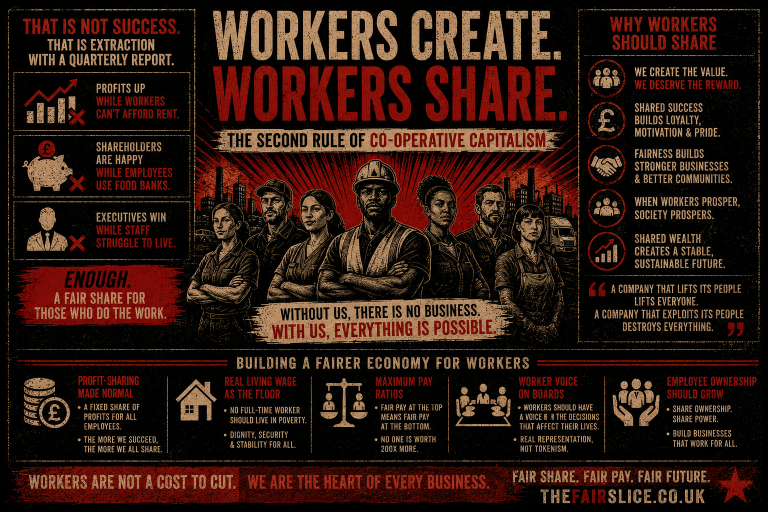

A company should not be called successful if its workers are struggling.
It should not be praised because its profits are up while its staff cannot afford rent.
It should not be celebrated because shareholders are happy while employees are using food banks.
That is not success.
That is extraction with a quarterly report.
The people who create the wealth should share in the wealth.
That is the second rule of Co-operative Capitalism.
Workers are not a cost problem
Modern business language often treats workers as a burden.
Labour costs.
Headcount.
Efficiency savings.
Restructuring.
Streamlining.
Reducing payroll.
Behind all those neat corporate phrases are actual human beings.
People with rent, mortgages, children, bills, illnesses, debts, hopes, stress and lives outside the spreadsheet.
But too many companies treat wages as something to suppress as much as possible so more money can be pushed upward to executives, owners and shareholders.
That is backwards.
Workers are not just a cost.
They are the business.
Without them, shelves do not get stocked.
Food does not get grown.
Customers do not get served.
Products do not get made.
Orders do not get delivered.
Systems do not get fixed.
Care does not get given.
Buildings do not get cleaned.
Businesses do not function.
If workers create the value, they should receive a fair share of it.
Profit-sharing should be normal
Under Co-operative Capitalism, profit-sharing would not be a nice extra.
It would be expected.
If a company does well, workers should benefit automatically.
Not just through the occasional bonus handed down like a treat.
Not through a token gift card.
Not through a pizza party while executives take home millions.
Actual profit-sharing.
A fixed portion of annual profit should be distributed to employees.
The more successful the company becomes, the more everyone shares in that success.
This would change the relationship between workers and employers.
Instead of staff being treated as replaceable units, they become recognised participants in the company’s success.
Instead of productivity gains flowing mainly upward, they are shared.
Instead of workers being asked to care about company performance while seeing none of the rewards, they would have a real stake.
That is not radical.
That is fair.
A real living wage should be the floor
No full-time worker should live in poverty.
That should be a basic rule of civilisation.
If someone works full-time, they should be able to afford housing, food, bills, transport, clothing, and a modest but decent life.
Not luxury.
Not extravagance.
Just stability.
If a business cannot pay a real living wage, then we need to ask whether that business is genuinely viable or whether it is being subsidised by worker hardship.
Because that is what poverty wages are.
They are a subsidy.
The worker pays through stress, debt and insecurity.
The taxpayer often pays through benefits and public support.
The business benefits by keeping labour cheap.
That is not efficiency.
That is cost-shifting.
A decent economy should not be built on workers absorbing the pain so owners can protect the margin.
Maximum pay ratios
There should also be a maximum pay ratio between the highest and lowest paid workers in a company.
If the cleaner, warehouse worker, shop assistant, care worker or junior employee is on low pay, then the people at the top should not be earning hundreds of times more.
Leadership matters. Responsibility matters. Skill matters.
But nobody is worth 200 or 300 times more than the people who keep the company running.
Extreme pay gaps are corrosive.
They tell workers that their effort is worth little.
They encourage executives to prioritise short-term financial performance over long-term stability.
They create a culture where those at the top are detached from the reality of those at the bottom.
A maximum pay ratio would not mean everyone earns the same.
It would simply mean that if leaders want to earn more, they have to bring everyone else up with them.
That is exactly how it should be.
Workers need a voice
Money is only part of the issue.
Workers also need power.
That means worker representation on company boards.
Not symbolic consultation.
Not an annual staff survey that disappears into a management folder.
Actual representation.
Workers should have a voice in decisions about pay, conditions, safety, automation, restructuring, outsourcing, investment and long-term strategy.
Because workers often understand the reality of a business better than the people making decisions from above.
They know what customers are actually saying.
They know where systems are failing.
They know when quality is slipping.
They know when staff are burned out.
They know when a policy looks good on a slide but collapses in real life.
Ignoring that knowledge is not just unfair.
It is stupid.
Employee ownership should expand
Co-operative Capitalism would also encourage more employee ownership.
Not every business has to be fully worker-owned, but medium and large companies should be required to build employee ownership stakes over time.
This could mean employee trusts, shared equity schemes, co-operative structures, or mixed ownership models.
The principle is simple:
If workers help build the value of a company, they should own part of that value.
This also makes businesses more resilient.
Companies with meaningful worker ownership are less likely to treat staff as disposable. They are more likely to think long term. They are more likely to value stability, quality and community impact.
That is the kind of capitalism worth keeping.
The basic test
Here is the test every business should face:
Are the people at the top doing well because the business is genuinely creating value?
Or are they doing well because the people underneath them are being underpaid?
If your company can afford dividends, executive bonuses, share buybacks, consultants, branding exercises and expansion plans, but cannot afford to pay workers properly, then the problem is not affordability.
The problem is priorities.
And if your business only works because your staff are underpaid, your business does not work.
It is being propped up by exploitation.
Co-operative Capitalism would end that lie.
Workers create the wealth.
Workers should share the wealth.