
Capitalism is not broken because people sell things.
It is not broken because people start businesses, take risks, invent products, open shops, build companies, employ staff, or try to make a better life for themselves.
Those things are not the problem.
The problem is what capitalism has been allowed to become.
We have built an economy where success is too often measured by how much wealth can be extracted, not how much value is created. A system where wages are treated as costs to be crushed, homes are treated as investment vehicles, essential services are turned into cash machines, and shareholders are treated as more important than workers, customers, suppliers, communities, and sometimes entire countries.
That is not healthy enterprise.
That is organised greed.
And the more I think about it, the more I come back to one idea:
Maybe we do not need to abolish capitalism completely.
Maybe we need to put a cage around it.
Maybe we need a form of capitalism that allows business, ambition, profit, innovation and private enterprise, but refuses to let greed become the organising principle of society.
I call that idea Co-operative Capitalism.
What is Co-operative Capitalism?
Co-operative Capitalism is capitalism with social rules.
It says businesses can make a profit, but not by exploiting workers.
It says people can become wealthy, but not so wealthy that they become more powerful than democracy itself.
It says shareholders can receive returns, but not before workers are paid properly, suppliers are treated fairly, prices are kept reasonable, and communities are respected.
It says essential services should not be treated like luxury goods.
It says food, housing, healthcare, water, energy, transport and care should not exist mainly as profit opportunities for investors.
It says politics should serve the public, not corporate donors, lobbying firms, media owners, billionaires and private interests.
In short:
Keep the market. Remove the greed.
This is not anti-business
The lazy response to this idea will be obvious.
Some people will say it is anti-business. It is not.
It is anti-exploitation.
There is a difference.
A good business should be able to thrive. A good business creates something useful, pays its workers properly, treats customers honestly, deals fairly with suppliers, contributes to society, and still makes a reasonable profit.
That should be encouraged.
What should not be encouraged is the parasite model of business.
The model where companies underpay staff, squeeze suppliers, inflate prices, dodge tax, lobby politicians, cut quality, outsource responsibility, and then funnel as much money as possible to executives and shareholders.
That is not business genius.
That is extraction.
And extraction is slowly breaking the country.
Why the current system is failing
Look around.
People are working full-time and still struggling.
Rent keeps rising.
Food keeps getting more expensive.
Energy companies make huge profits while people are scared of winter bills.
Public services are stretched to breaking point.
Teachers, nurses, carers, council workers, farmers and other essential people are told there is no money, while billionaires somehow keep getting richer.
Everywhere you look, the same pattern appears.
Money moves upward.
The people doing the work get squeezed.
The people needing the service get squeezed.
The people owning the assets get richer.
That is the core problem.
It is not just that some people are rich. It is that the entire system has been designed to keep pushing wealth, power and security upward while ordinary people are told to be grateful for scraps.
The seven rules
This series will set out a different model.
Not a perfect model. Not a magic solution. Not a fantasy where everyone holds hands and greed disappears overnight.
But a serious starting point.
Co-operative Capitalism would be built around seven rules.
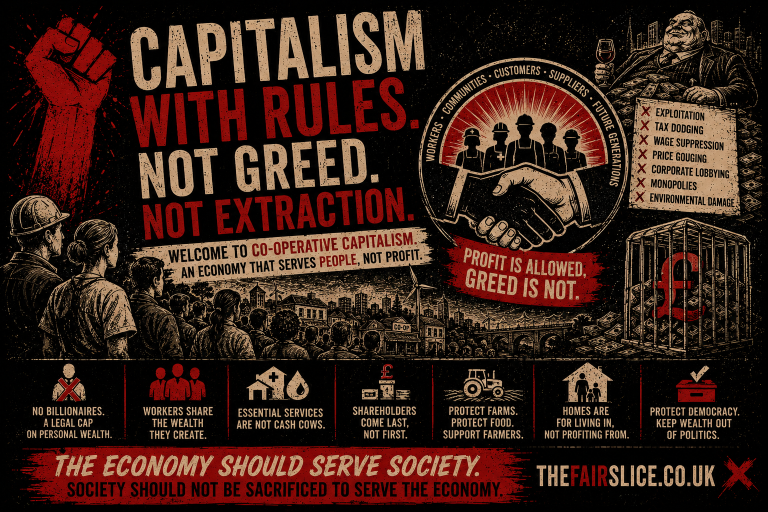
First, nobody becomes a billionaire. There should be a legal cap on personal wealth. Once someone reaches £999 million, they have won capitalism. Everything above that should be taxed and used for the public good.
Second, workers should share the wealth they create. If a company succeeds, the people who made that success possible should benefit directly.
Third, essential services should not be cash cows. Food, housing, water, energy, healthcare, childcare, transport and care should be protected from excessive profiteering.
Fourth, shareholders should come last, not first. Workers, customers, suppliers, communities and public obligations should come before dividends and share buybacks.
Fifth, farms and food should be protected. Farmers should not be squeezed at one end while customers are ripped off at the other.
Sixth, homes are for living in. Housing should be treated as shelter and security, not primarily as an investment product.
Seventh, politics must be protected from wealth. Democracy cannot work properly if the richest people and biggest companies can quietly buy access, influence and policy.
These rules are not extreme.
What is extreme is allowing a tiny number of people to accumulate more wealth than they could spend in a thousand lifetimes while the workers, services and communities that made their wealth possible are left to decay.
The point of the economy
The economy is not a natural disaster.
It is not weather.
It is not gravity.
It is a set of rules. Those rules are written by people. They can be rewritten by people.
So the real question is not whether we can change the economy.
The real question is who the economy should serve.
Should it serve billionaires, shareholders, landlords, monopolies, corporate donors and executive boards?
Or should it serve workers, families, communities, farmers, small businesses, public services and the people who actually keep the country running?
Co-operative Capitalism starts with a simple answer:
The economy should serve society.
Society should not be sacrificed to serve the economy.
That is the idea.
Now let’s build the rules.