
There is a particular kind of greed that society has learned to admire.
We do not call it hoarding.
We call it success.
We do not call it extraction.
We call it growth.
We do not call it obsession.
We call it ambition.
And sitting at the centre of this sickness is one of the most destructive inventions in modern economic life: the shareholder.
Not the small-time pension holder with a few investments tucked away somewhere. Not the ordinary person trying to build some security in a rigged system. I mean the shareholder as a force. The faceless ownership class. The people and institutions that demand more, always more, forever more, while someone else pays the price.
The shareholder does not care whether nurses can afford rent.
The shareholder does not care whether teachers are exhausted.
The shareholder does not care whether customers are being ripped off.
The shareholder does not care whether workers are underpaid, overworked, monitored, stressed, replaceable, and discarded.
The shareholder cares about return.
That is the entire moral universe.
More profit. More dividends. More buybacks. More margin. More growth. More extraction. More pressure. More cuts. More “efficiency”. More human beings squeezed into numbers on a spreadsheet.
And because of that, the shareholder has become one of the great blights on mankind.
Not because investment itself is evil. Not because businesses should never make profit. But because we have allowed passive ownership to become more powerful than labour, community, service, skill, duty, decency, and the basic needs of human life.
A business used to have some connection to the people it served and the people it employed. It made something. It sold something. It had a reputation. It had limits.
Now too many businesses exist to feed people who may never visit the factory, speak to the staff, use the service, or live in the community affected by their decisions.
They just want their cut.
And if that means cutting jobs, fine.
If that means raising prices, fine.
If that means reducing quality, fine.
If that means closing branches, automating roles, dodging tax, suppressing wages, lobbying politicians, or destroying local competition, fine.
As long as the line goes up.
This is not healthy. It is not clever. It is not progress.
It is a form of socially accepted madness.
And we need to talk about the billionaire mindset in the same way.
Because wanting to be comfortable is normal. Wanting security is normal. Wanting a good home, good food, a decent life, freedom from fear, and the ability to enjoy yourself is normal.
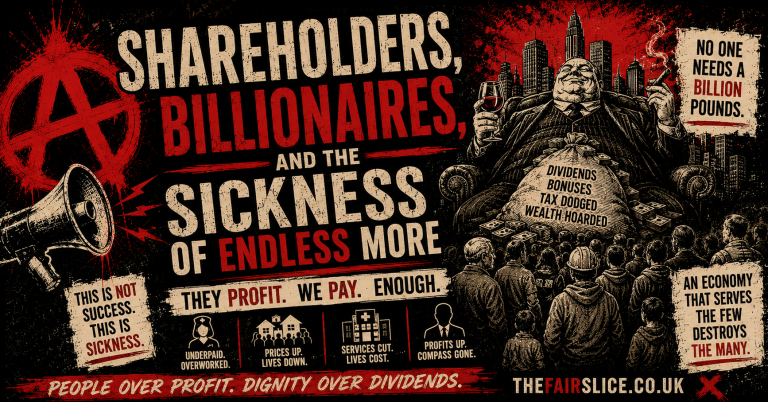
But wanting a billion pounds is not normal.
A billion is not wealth in any ordinary human sense. It is not “doing well”. It is not financial freedom. It is not a reward for hard work.
It is a level of accumulation so grotesque that it stops being about need, comfort, or even luxury. It becomes domination.
A person does not need a billion pounds. They do not need ten billion. They certainly do not need a hundred billion. And the idea of a trillionaire should horrify us, not impress us.
At some point, the endless desire for more becomes pathological.
Now, to be clear, I am not saying greed is a clinical mental illness. That would be too easy, and frankly unfair to people who actually live with mental illness. What I am saying is that extreme wealth obsession looks like a moral sickness. A defect in empathy. A failure to recognise other human beings as equally real.
Because what kind of person looks at a world with food banks, homelessness, collapsing public services, underpaid carers, exhausted nurses, and children growing up in poverty, and still thinks: “What I really need is more”?
What kind of society looks at that person and says: “Genius”?
There is something deeply broken in a culture that treats extreme accumulation as aspirational.
If someone hoarded houses while others slept on the street, we called them a property magnate.
If someone hoarded food while others starved, we would call them a monster.
If someone hoards money while workers cannot afford to live, we put them on magazine covers.
That is the sickness.
And the comparison to serial killers is uncomfortable, but there is a reason it lands. Not because billionaires are literally the same as murderers. They are not. But because both reveal something disturbing when human empathy is removed from the equation.
The serial killer treats people as objects.
The extreme wealth hoarder treats people as inputs.
Workers become costs.
Customers become revenue streams.
Homes become assets.
Healthcare becomes a market.
Education becomes a product.
Suffering becomes acceptable collateral.
The violence is different. The mechanism is different. But the underlying moral failure has a familiar shape: other people become less important than the private desire of the person taking from them.
That should disturb us more than it does.
Instead, we have built an economy that rewards it.
We tell companies that their primary duty is to maximise shareholder value. Not to pay workers properly. Not to serve communities. Not to build useful things. Not to protect the environment. Not to contribute fairly to society.
Maximise shareholder value.
That one phrase has done enormous damage.
It has justified wage suppression.
It has justified price gouging.
It has justified tax avoidance.
It has justified outsourcing.
It has justified the destruction of local economies.
It has justified turning essential services into profit machines.
And then, when ordinary people cannot afford to live, the same system tells them they should budget better.
It is obscene.
The truth is simple: no one becomes a billionaire alone.
Every fortune sits on top of public infrastructure, workers, customers, legal systems, roads, schools, hospitals, energy grids, communications networks, state-funded research, and generations of social stability. Wealth is not created in a vacuum. It is extracted from a society.
So society has every right to set limits.
We should not be asking how to create more billionaires.
We should be asking why we allow billionaires at all.
There should be a ceiling.
A hard one.
Past a certain point, wealth should be taxed back into society. Not as punishment, but as maintenance. As democratic self-defence. As a reminder that the economy exists to serve human beings, not to crown a tiny class of economic kings.
The same applies to shareholders.
Investment should have responsibilities attached. If you profit from a business, you should not be allowed to do so at the expense of its workers, customers, suppliers, communities, or the country that made the business possible.
Profit should come after fair wages.
Profit should come after safe conditions.
Profit should come after tax.
Profit should come after decent service.
Profit should come after social responsibility.
Not before.
We need to stop treating shareholders as sacred. They are not. They are simply one interested party among many — and in many cases, the least useful one.
The worker matters more.
The customer matters more.
The community matters more.
The public good matters more.
A functioning society cannot be built around the appetites of people who already have too much.
Because endless growth for shareholders means endless pressure on everyone else.
It means your bills go up.
Your wages stagnate.
Your services get worse.
Your job becomes less secure.
Your town centre dies.
Your public services are starved.
Your life gets harder so someone wealthier than you can become wealthier still.
That is not an economy.
That is a machine for turning human effort into private excess.
And it is time we stopped applauding the people sitting at the top of it.
The desire to become a billionaire should not be admired. It should be questioned. The desire to become a trillionaire should not be discussed as some exciting future milestone. It should be treated as a warning sign that society has completely lost its moral compass.
No one needs that much.
No one earns that much.
No one should be allowed to take that much from the world while others are struggling to survive in it.
Shareholders have had their age. Billionaires have had their worship. The cult of endless more has hollowed out too much already.
The next economy should not ask how much value can be extracted from people.
It should ask how much dignity, security, fairness, and freedom can be returned to them.
Because mankind does not need more billionaires.
It needs fewer parasites.