
We are told, constantly, that there is no money.
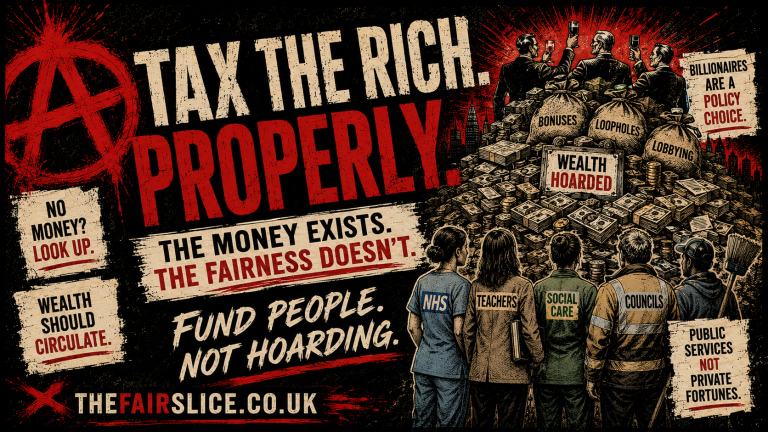
No money for the NHS.
No money for teachers.
No money for social care.
No money for councils.
No money for decent public services.
No money to help people drowning in rent, bills, debt, and stagnant wages.
But somehow, there is always money at the top.
There is money for shareholder payouts.
There is money for executive bonuses.
There is money for tax avoidance schemes.
There is money for corporate lobbying.
There is money for people who already have more than they could spend in ten lifetimes.
So maybe the problem is not that society has no money.
Maybe the problem is where the money is allowed to sit.
Taxing the rich is not punishment. It is maintenance. It is the price of living in a functioning society. The wealthy do not build their fortunes in a vacuum. They rely on roads, schools, hospitals, courts, workers, customers, infrastructure, public order, and the stability created by everyone else.
A fair tax system simply says: if you benefit the most from society, you should contribute properly to keeping it alive.
That means taxing wealth, not just wages.
That means closing loopholes.
That means making billionaires impossible, not aspirational.
That means refusing to let nurses, teachers, carers, cleaners, farmers, and ordinary workers carry the burden while the richest treat tax like an optional inconvenience.
Because a country that cannot afford hospitals but can afford billionaires has not run out of money.
It has run out of fairness.