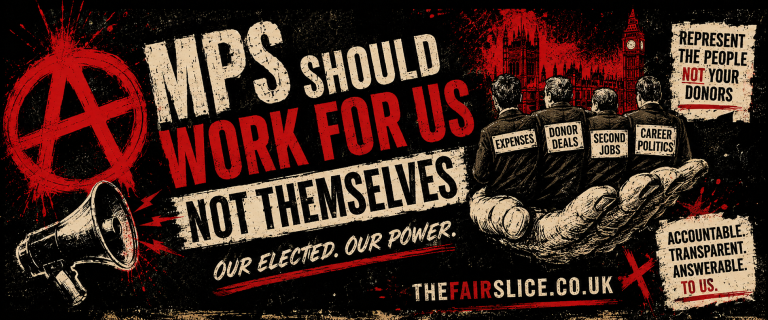

Politics should not be a side hustle.
If you are elected to represent thousands of people, that should be the job. Not one income stream among many. Not a stepping stone to consultancy work. Not a networking opportunity. Not a way to build a personal brand while the people who voted for you struggle with rent, bills, waiting lists, food prices, and wages that do not stretch far enough.
Being an MP should be public service.
That should not be controversial.
Most ordinary people are expected to turn up, do their job properly, avoid conflicts of interest, and behave professionally. If they used their workplace to benefit another employer, they would probably be disciplined. If they took gifts from people who wanted favourable treatment, questions would be asked. If they treated their main job like a part-time inconvenience, they would not last long.
So why do we accept a different standard from the people running the country?
MPs are currently allowed to have second jobs, although they are restricted from providing paid parliamentary advice and must register financial interests. But the issue is not only what is technically allowed. The issue is what it says about priorities.
If someone is paid to represent the public, their loyalty should be clear.
Not split.
Not blurred.
Not technically compliant but morally questionable.
Because when politics gets too close to private money, the public loses trust. And rightly so. People are not stupid. They can see when the system bends toward those with access, wealth, and influence. They can see when public servants appear more interested in media deals, corporate work, donations, hospitality, and future career options than the people they were elected to serve.
This matters because politics decides who gets protected and who gets squeezed.
It decides whether nurses are paid properly. Whether teachers have enough support. Whether the NHS is funded. Whether renters are protected. Whether corporations are challenged when they raise prices while posting huge profits. Whether tax is collected fairly. Whether ordinary people get help, or just another lecture about being realistic.
And here is the problem: if the people making those decisions are surrounded by wealth, influenced by wealth, or personally benefiting from wealth, then policy will always lean in that direction.
Not always openly. Not always corruptly. Not always illegally.
But gradually.
Quietly.
Predictably.
That is how unfair systems survive. Not because everyone involved is cartoonishly evil, but because the incentives are rotten. The powerful get meetings. The wealthy get access. The donors get listened to. The lobbyists get time. Meanwhile, ordinary people get told there is no money left.
There should be a simple rule:
If you want to be an MP, be an MP.
That means no second jobs except for genuinely necessary public-interest exceptions, such as medical professionals keeping limited practice for safety or registration reasons. No paid consultancy. No corporate advisory roles. No paid lobbying. No using Parliament as a shop window for private income.
It also means much stricter rules on gifts, hospitality, donations, and outside influence. Everything should be published clearly, quickly, and in a way ordinary people can actually understand. Not buried in some register that technically exists but requires effort to decode.
And yes, MPs should be paid fairly. This is not about pretending elected representatives should live on nothing. If anything, paying MPs properly helps stop politics becoming something only the already-rich can afford to do.
But a fair wage should come with fair expectations.
Turn up. Do the job. Serve the public. Avoid conflicts. Stop treating politics like a career ladder with perks.
Because right now, too many people look at Westminster and see a different world. A world of expenses, donors, private events, lobbying, second incomes, and rules that always seem more flexible for those at the top than for everyone else.
That is poisonous for democracy.
People will not trust a political system that appears to serve itself. They will not trust politicians who tell the public to tighten their belts while enjoying privileges most workers could never dream of. They will not believe in sacrifice from leaders who do not seem to sacrifice anything themselves.
Politics should be boringly clean.
Public money should serve the public. Public office should serve the public. Public representatives should serve the public.
That is the standard.
Not “was it technically within the rules?”
Not “did they declare it?”
Not “can they justify it?”
The question should be much simpler:
Are they working for us, or are they working for themselves?